Friday, September 9, 2011

goblet of death (vault of the adepti)


The fourth Harry Potter book, Goblet of Fire, is the path of Temperance.


Here, Harry must complete a series of tasks in the Triwizard Tournament. He has no wish to enter this contest, as the stakes are high and the path is treacherous. But, the Grail (the Goblet of Fire) chooses him; he is compelled by fate and circumstance (and "a binding magical contract") to do so.


Dumbledore now took out his wand and tapped three times upon the top of the casket. The lid creaked slowly open. Dumbledore reached inside it and pulled out a large, roughly hewn wooden cup. It would have been entirely unremarkable had it not been full to the brim with dancing blue-white flames.  

The Goblet of Fire itself is found inside a coffin, hinting, with true Masonic flair, at life from philosophic death.


Harry must, first of all, defeat the fire-breathing dragon. Before this task, Ron (Sulphur) has deserted him; his triumph over the dragon, at great personal risk (with the help of his trusty Firebolt broom--fight fire with fire), is the event by which he is also reunited with Ron, who once more becomes his faithful ally.


Harry's fellow contestant Fleur Delacour defeats the dragon by pouring water on it (Temperance). She will become more significant later.

In a typical instance of teenage melodrama, the boys of Hogwarts are compelled to find dates for the school dance--that is, Harry must now get in touch with his feminine side. But at this stage, no-one has the right partner.


Harry must then, conformable to the alchemical mythos, take the dragon's golden Philosopher's Egg and learn how to hatch it. The egg has various alchemical symbols on it. To open the egg and complete the next task, Harry must suffer an immersion in the Bath.

"The wand chooses the wizard?"

The Living Dead Girl, Moaning Myrtle (MM), again greets Harry here in the prefects' bathroom. (Room 217 in the Overlook?)

(John Granger)


Harry must then descend into the unconscious to rescue his friends from a watery death. (It will be seen here that these tasks are meant to symbolize the entirety of the alchemical opus, as, indeed, does the Temperance card itself.)


In the third and final task, Harry must navigate a labyrinth and literally answer the Riddle of the Sphinx before finding the Grail, which, of course, is the same as the end of the second book.
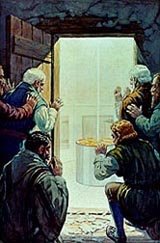

His lower initiation having been completed, Harry now becomes an Adept and travels through a "Portkey," which corresponds to the "Portal" grade that leads to the Inner Order of the Golden Dawn. 


The First Order Grades were related to the four elements of Earth, Air, Water, and Fire, respectively. The Aspirant to a Grade received instruction on the metaphysical meaning of each of these Elements and had to pass a written examination and demonstrate certain skills to receive admission to that Grade. 

[Compare this to the yearly exams at Hogwarts--the Triwizard competition was originally designed to have four trials relating to the four elements, says Rowling.]

The Portal Grade was an "Invisible" or in-between grade separating the First Order from the Second Order.[36] The Circle of existing Adepts from the Second Order had to consent to allow an Aspirant to be initiated as an Adept and join the Second Order.

The Second Order was not, properly, part of the "Golden Dawn", but a separate Order in its own right, known as the R.R. et A.C. The Second Order directed the teachings of the First Order and was the governing force behind the First Order.
 ("Hermetic Order of the Golden Dawn")

But instead of attaining a quick and painless enlightenment, Harry here discovers firsthand that the Grail is full of poison. Voldemort has killed a woman named "Bertha"--i.e. Harry's "birth" is accompanied by an evil Shadow (as per Mother Monster). Harry instead "rebirths" Voldemort, infusing it with his own "blood" (libido energy).


Voldemort's rebirthing is on the grave of Tom Riddle (Christian Rosenkreuz)--i.e. the Vault of the Adepti, where Harry Potter becomes a member of the RR et AC. Tom Riddle is named after his father; i.e. he inherited Adam's derangement.

Under the guidance of MacGregor Mathers, the Vault of the Adepti became the initiation chamber of the Golden Dawn’s Second or Inner Order. The Adeptus Minor Ceremony is largely centered around the story of the discovery of the tomb of Christian Rosenkreutz. The Fama describes the Rosicrucian Vault as the Tomb of Christian Rosencreutz. . . . unlike Christ, CRC is not resurrected, although his body is perfectly preserved. His tomb is a tomb of Death.

And yet the opening of CRC’s tomb announces the rebirth of the mysterious Rosicrucian Brotherhood as portrayed in the Fama. Therefore the Vault is a symbol of death and spiritual resurrection.

In the Adeptus Minor Ceremony of the Golden Dawn, the officer known as the Chief Adept represents an Initiate who has undergone this alchemical process of self-transmutation and spiritual evolution. The Chief Adept, representing Christian Rosencreutz at one point in the ritual, tells the Aspirant:

"Buried with that Light in a mystical death, rising again in a mystical resurrection, cleansed and purified through Him our Master, O Brother of Cross and the Rose. Like Him, O Adepts of all ages, have ye toiled. Like Him have ye suffered tribulation. Poverty, torture and death have ye passed through. They have been but the purification of the Gold. In the alembic of thine heart, through the athanor of affliction, seek thou the true stone of the Wise."

In the Adeptus Minor Ceremony of the Golden Dawn the tomb of Christian Rosencreutz has another name: This place was entitled by our still more ancient Fratres and Sorores, the Tomb of Osiris Onnophris, the Justified One.
(Chic Cicero)


The Voldemort homunculus is the Eraserhead child. The child of this union is noxious and repugnant, but it is Harry's and, like Sophia's abortion, he must see it through to its proper birth. There is no turning back.


The Death Eaters, Voldemort's loyal followers, are the Eyes Wide Shut masketeers. "Well imagine their surprise when the realize the Black Lodge is inside them!"

The death of innocence.

Voldemort claims his first new victim, Cedric Diggory, who represents the outgoing, healthy, and altogether normal personality that is irrevocably lost when the Shadow is revealed. His loss will be missed most of all, even if, it is admitted, he was not actually very bright (being unconscious of his darker half).

The Order of the Phoenix is composed of two real occultists: Aleister Crowley (Alastor Moody, middle) and Eliphas Levi (Elphias Doge, far right). 

In the Potter series, many people are named after famous members of the Occult Revival, showing that Rowling does her homework. (Is literally everyone in on the joke? Fred and George Weasley are jokers.) Elphias Doge is obviously named after Eliphas Levi. Cassandra Vablatsky is H.P. Blavatsky. Harry spends a lot of time with Arthur Weasley--Arthur Waite?

Aleister Crowley and Alastor Moody

In Goblet of Fire we are also introduced to the character of Alastor Moody, who is quite clearly based upon Aleister Crowley. Moody has a "mad eye" (which again refers to the white and black Crowleys). Potter is all about the Father-imago--"Defence Against the Dark Arts" = DADA, and there's a new teacher (read: Hierophant, Le Pape) every year. They all express the principle of duality; Quirrell's shadow is Voldemort; Gilderoy Lockhart is an egotistical liar; Lupin is secretly a werewolf.

S.L. MacGregor Mathers and Bartemius Crouch, Sr.

Young Aleister Crowley and Bartemius Crouch, Jr.

Aleister Crowley "betrayed" his "father" S.L. MacGregor Mathers when he published the secrets of the Golden Dawn. In Goblet of Fire, there is an impostor Alastor Moody, Bartemius Crouch Jr., who killed his father, Bartemius Crouch Sr.--this seems to be a reference to Aleister Crowley allegedly killing S.L. MacGregor Mathers with black magic. But the good Alastor is a member of the Order of the Phoenix (the Argenteum Astrum--the Illuminati).

The impostor Alastor is revealed.

As I have mentioned before, there are, in effect, two Aleister Crowleys, as all of his writings operate on multiple levels of meaning. In their outer, exoteric sense, they are little more than  a farrago of black magic and nonsense, but the sincere student will ascertain that the inner, esoteric doctrine of rebirth is hidden beneath the surface. (This is, additionally, a metaphor for the Potter books themselves, where magic[k] is used as a metaphor for inner alchemy.) The unmasking of the impostor Alastor Moody at the end of Goblet of Fire is merely a way of showing that Harry has now attained to the Greater Mystery--"the initiate is now passing from the Lesser Mysteries of the Outer Order of the GD to the Greater Mysteries of the Inner Order of the RC & AA." The "real" Moody is, appropriately enough, found at the bottom of a bewitched magical trunk with seven locks. (That is, the true doctrine of the Mysteries is guarded by seven veils.)

Having attained to the Second Order, Harry will now encounter the Dweller on the Threshold of the Abyss--this is the subject of the fifth book, The Order of the Phoenix. (The Order of the Phoenix represents the Invisible Chiefs of the 3rd Order--and includes in its ranks, of course, Crowley/Moody himself.)



“I learned that the world has a soul, and that whoever understands that soul can also understand the language of things. I learned that many alchemists realized their destinies, and wound up discovering the Soul of the World, the Philosopher’s Stone, and the Elixir of Life. But above all, I learned that these things are all so simple they could be written on the surface of an emerald.” The Alchemist by Paulo Coelho

Where ya headed Dorothy?

“All you have to do is contemplate a simple grain of sand, and you will see in it all the marvels of creation. Listen to your heart. It knows all things, because it came from the Soul of the World, and it will one day return there.” The Alchemist by Paulo Coelho

(I found the entire universe in this issue of the New Yorker)

“There is only one way to learn,” the alchemist answered. “It’s through action. Everything you need to know you have learned through your journey” 

"You’ve got to find the treasure, so that everything you have learned along the way can make sense."


9/11 Glamour


glamour |ˈglamər| (also glamor)nounthe attractive or exciting quality that makes certain people or things seem appealing or special the glamour of Monte Carlo [as adj. the glamour days of Old Hollywood.• beauty or charm that is sexually attractive George had none of his brother's glamour.• archaic enchantment; magic that maiden, made by glamour out of flowers.[Rebelle Fleur]ORIGIN early 18th cent. (originally Scots in the sense [enchantment, magic] ): alteration of grammar . Although grammar itself was not usedin this sense, the Latin word grammatica (from which it derives) was often used in the Middle Ages to mean [scholarshiplearning,] including the occult practices popularly associated with learning.

"I Need to Open Up."


And as they did eat, Jesus took bread, and blessed, and brake it, and gave to them, and said, 


Take, eat: this is my body.


It follows from these elucidations that the higher understanding of the Eucharist and the mystic side of alchemy are concerned with the same subject, that is to say, with man, his p. 547 conversion and transfiguration: the implicits are therefore the same, and of these things alchemy was the next witness in the world after the epoch of the Holy Graal. . . .

So, therefore, the Stone transmutes and the Eucharist transmutes also; the philosophical elements on the physical side go to the making of the Stone, which is also physical, and the sacramental elements to the generation of a new life in the soul. He who says Lapis Philosophorum says also: My beloved to me and I to him. Christ is therefore the Stone, and the Stone in adept humanity is the Union realised, while the Great Secret is that Christ must be manifested within.
(Arthur Waite)

Friday, September 2, 2011

why so sirius (black)

Cronos was banished, some say to the depths of the underworld, but others say to the blessed Isles where he sleeps, awaiting the beginning of a new Golden Age (52). ~Mythic Tarot


For me, in the Harry books it is not a different world, it's simply a world we can't see: we're muggles, it's right under our noses. (J.K. Rowling)

AZKABAN


In the third book of the Harry Potter series, The Prisoner of Azkaban, we find ourselves hurdled into the Nigredo phase of the Great Work.


Harry Potter's age always corresponds to the Tarot card he's currently experiencing--he turns 13 at the beginning of Azkaban, which indicates his encounter is with Death (Osiris is a Sirius Black God). Here, Harry is constantly reminded that he has been marked for Death, pursued by Dementors and the Grim.

The first stage of the alchemical work is dissolution, usually called the nigredo or the black stage. In this black, initial stage, “the body of the impure metal, the matter for the Stone, or the old, outmoded state of being is killed, putrefied, and dissolved into the original substance of creation, the prima materia, in order that it may be renovated and reborn in a new form.” Harry’s godfather, Sirius Black, is named for this stage of the work. (John Granger)


The Dementors are clearly meant to represent the depression of the Dark Night of the Soul. After Sirius Black escapes, the Muggle world and the Wizard world start to interpenetrate.

The third book, Harry Potter and the Prisoner of Azkaban, contains the Dementors, the most frightening creatures who destroy every happy memory you ever had and whose kiss sucks out your very soul. 'They represent the coldness and dreadness of clinical depression. Anyone who's had it knows that feeling of emptiness. You can't imagine not having it. (Rowling)

We have gazed in the Abyss, and now the Abyss seems to gaze back and wrap its icy fingers around us—but who is doing the gazing? It is Osiris, the Lord of the Dead, and he holds the mystic rose. In the distance, we see the Secret Sun of the Self (i.e., Sirius) rising out of the abyss. And yet Osiris is man himself in his natural state (Sirius is played by Gary Old-Man), a being of half-flame and half-darkness. Thus there is joy in death, for we have come to understand the Hidden God, the dark primordial source of all things within ourselves. And we know that a new life will emerge from it.

The previous paragraph is nearly verbatim from my article in The Sync Book, and describes the content of Azkaban with uncanny accuracy. Osiris is, most naturally, Sirius Black, Harry's hidden Godfather. In the end, the significance of all of this is revealed: Dumbledore tells Harry that he discovered his father within himself. Rowling is hitting us over the head with this stuff, and no-one is listening. They wouldn't, of course, because they would have to "become as little children" to get the message.

You think the dead we loved ever truly leave us? You think that we don't recall them more clearly than ever in times of great trouble? You father is alive in you, Harry, and shows himself most plainly when you have need of him.... You know Harry, in a way, you did see you father last night.... You found him in yourself.

Osiris risen.

Sirius Black the Godfather is Barack Obama--once feared as the enemy (Iraq Hussein Osama), he now becomes the King. Anyone who had read these books should've been able to predict the election. (*...speaking of Black...*)


There is a new teacher (Hierophant) for Defence Against the Dark Arts, or DADA, representing the current Father-imago. Harry's discovery in Azkaban is that Remus Lupin has a dark shadow aspect, representing the untamed beast within--he is a werewolf. Sirius Black, too, has a dual nature, being able to transform himself into a black dog. (Rowling endlessly multiplies characters; when they embrace in the last part of the book, it is evident that they represent a similar idea.)

John Granger submits the idea that Lupin is further meant to represent an ideal sort of Jungian psychoanalyst, one who has learned how to keep his Shadow in check and lead a relatively normal life, but not how to overcome it. (To do so will require the path of Temperance, which is the subject of the next book, Goblet of Fire.) This is the most that the majority of people can aspire to.


Remus instructs them on how to confront Boggarts, who take the form of one's worst fears and lurk in dark and enclosed spaces (of the psyche, we might add).

Horny?

James Potters' choice of the stag form to preserve himself deserves comment. The stag has archaic symbolic links to the Tree of Life due to the resemblance of its antlers to the cyclic life of branches. It is also seen as the forerunner of daylight or guide to the light of the Sun; it is a harbinger of supreme consciousness. In alchemy the cervus fugitivus, the fugitive stag, is often the name for the highly elusive, metamorphosing Spirit Mercurius. (Gail Grynbaum)

Harry's father and his school chums never really died; they became animals. In other words, Harry's father is the Hanged Man--the latens deitas in nature. To defeat the Dementors, Harry must learn to conjure a Patronus with his wand, which esoterically takes the form of his father (Superdickery). This recalls the story of King Nebuchadnezzar, who was transformed into a beast in the 4th chapter of Daniel. The Olympian gods were said to have transformed themselves into animals in Egypt in order to hide from an even more horrendous force.

She sings, from Earth's dark womb how Typhon rose,
And struck with mortal fear his heav'nly foes.
How the Gods fled to Egypt's slimy soil,
And hid their heads beneath the banks of Nile:
How Typhon, from the conquer'd skies, pursu'd
Their routed godheads to the sev'n-mouth'd flood;
Forc'd every God, his fury to escape,
Some beastly form to take, or earthly shape.
(Ovid)


Man, as a mortal god, is caught between beast and angel.

Inside the Clock Tower.

The subject of Azkaban is time, and the possibility of reversing it. Time represents entropy; in a completely closed system, the universe will eventually decay into chaos. Fortunately for us, Harry is an alchemist and can reverse this process.


Hermione, or alchemical Mercury, is the agent by which Harry is able to rescue his Godfather Sirius (and, by extension, himself) from a fate worse than death at the hands of soul-sucking Dementors. Hermione, thanks to her Time-Turner, has the ability to turn back time.

Prof. Huey Lewis would indicate that the power of love (or perhaps plutonium) is what makes time travel possible. 

THOTH (Mercury) is 88 in Greek Gematria, and the speed at which Marty McFly must travel to go back to 1955 and perform the Alchemical Wedding on his parents.

Coniunctio.

If my calculations are correct, when this baby hits eighty-eight miles per hour... you're gonna see some Sirius shit.

8/8

And yet everything that happens in Azkaban due to the Time-Turner had already happened before they went back in time. (The Predestination Paradox.) Therefore, one can't go back in time to kill Tom Riddle because none of the characters have free will, being Rowling's puppets. But esoterically, of course, one is indeed "going back in time" and reversing the process of entropy that would have eventually destroyed the universe. This is Jacob stealing Esau's birthright.


Chamber of Secrets, which we previously saw, is a retelling of the Esau and Jacob story in Genesis. (The students, by the way, are studying Transfiguration.)
  • Rebekah schemes to take away the blessing from Esau by disguising Jacob.
  • Hermione concocts a potion to temporarily transform Harry and Ron into Slytherins. (This motif will be duplicated in later books.)
  • Later in the book, Harry (Jacob) must defeat Tom (= "twin," i.e. Esau) Riddle, the Heir of Slytherin.
Isaac, blind and infirm as he is, must represent the Demiurge, since Jacob schemes to get his blessing in one chapter and God's blessing in another. Isaac's heir, the hairy ("heiry") beast-man Esau, represents a sort of devolution into blind animalism and chaos, which would be the natural state of things without the intervention of Sophia/Rebekah. Jacob must clothe himself in animal skin; i.e. take the energy of the Beast or Basilisk that has been stolen by Esau/Tom and use it for regenerative purposes.

That is, in order to claim the blessing of the Father, Jacob (the Ma Son) has to become just as "Harry" as Esau (the randy savage) is. A mess of Potterage? Mythologically, Horus (Jacob) steals (takes back) the blessing from Set (Esau), with Isis' blessing.

Time, as in Captain Hook with his Saturnian scythe, is the enemy of Peter Pan. 


Quidditch, illogical though it is, is a metaphor for life. It doesn't really matter what the other players battling it out in the checkerboard of duality do; only the Great Work (represented by the Snitch) is important.

The introduction of Quidditch in the world of Harry Potter is steeped in alchemic and archetypical symbolism. As the Seeker for the Gryffindor team, Harry’s job is to find and catch the Golden Snitch. However, the word Seeker describes Harry wonderfully–he truly is a seeker, a seeker of truth and enlightenment. The Bludgers represent the obstacles along the way, as he tries to duck and dodge the events that conspire to keep him from his goal. The Golden Snitch, however, is the most important object in the game. A tiny gold ball with wings, the Snitch represents the higher planes of consciousness—the Philosopher’s Stone. The Harry Potter Lexicon describes Bowman Wright, the man who invented the Golden Snitch, as a “metal charmer,” which is another name for a metallurgist, or alchemist. (Arianhrod)

But it is also a metaphor for sex. Quidditch is Harry's Charioting, wherein he has to fight Draco, or the reptilian "I" asserting itself, in order to win the golden ball (a perfect fuck) . . .


But mind, never at ease, creaketh "I".
This I persisteth not, posteth not through genera-
tions, changeth momently, finally is dead.
Therefore is man only himself when lost to himself
in The Charioting.
(Alastor "Mad-Eye" Crowley, Book of Lies)

In the second book, Harry's arm goes "limp" in the second book after falling off of his "broom" and he has to regrow his "bones." In the third, it is the Dementors who cause Harry to "fall." (Who said these books were for kids? They're filthy.)

Quidditch is a dirty, filthy game that should not be viewed by anyone at all, let alone children. Let's start with the obvious: The game is played by having each player climb on top of a long wooden shaft. Then everyone rides their shafts around, trying to "beat off" the other shafts flying all over the place and chasing balls around the field.

(This, however, is the Lesser Mystery, the Greater Mystery of the Philosopher's Stone inside the Snitch will be revealed in the seventh book.)


Hermione transforms into a cat in the second book; in the third she gets a cat. Again, the Lunar Mercury is implied; a "cat" being cathar, or purified animal energy. (And rightly so, as blue fire is Hermione's trademark. The Patronus has a similar significance.) Harry the alchemist, as usual, must spend a great part of the book getting the "quarreling couple" of Mercury (Hermione) and Sulphur (Ron) to talk to each other. Ron mistakenly fears that Hermione's cat has "eaten" his rat, i.e. that the Mercury has completely absorbed the Sulphurous energy into itself.

The alchemical work purifies a base metal by dissolving and recongealing the metal using two principal reagents or catalysts. These reagents reflect the masculine and feminine polarities of existence. “Alchemical sulfur” represents the masculine, impulsive, and red pole, while “quicksilver” or “alchemical mercury” represents the feminine and cool complement. Together and separately these reagents advance the base metal to gold.

Harry’s two closest friends are Ron Weasley, the redheaded, passionate boy, and Hermione Granger, the brilliant, cool young woman. They are also living symbols of alchemical sulfur (Ron) and mercury (Hermione). Together, and more obviously, in their disagreements and separation, Harry’s friendships with Ron and Hermione transform him from lead to gold. Sulfur and quicksilver are frequently called “the quarreling couple,” an apt name for Ron and Hermione.
(John Granger)

Half-lit spinal columns resonate half-risen Kundalini.

"Death" in the Thoth Tarot, showing, again, a half-risen Kundalini serpent (left) and spinal column in prominence.


While in the first book Ron's rat (RATS=STARS backwards) was described as sitting on his lap (lap-sit exillis), in the third book Rowling makes a point of telling us that it sits in a pocket on his chest--meaning, of course, that the Sulphur has now risen to the level of the heart. Esoterically, Ron is Scabbers, who is revealed to be Peter Pettigrew. "Peter," or "Wormtail" (that is, the "tail" end of the Kundalini) betrayed Sirius (i.e. committed a naked act of lust), just as Peter denies Christ three times. Set slew Osiris.


Peter Pettigrew was the Potters' "Secret-Keeper," which obviously relates to the Secret Word of the Master-Builder Hiram Abiff (James Potter). The Word is the Logos. (The Three Ruffians who murder Hiram-James perhaps being Snape, Voldemort, and Wormtail.) 

In this play, Hiram is presented as being the chief architect of King Solomon's Temple, who is murdered by three ruffians during an unsuccessful attempt to force him to divulge the Master Masons' secret password.


In subsequent books, Ron becomes a "Keeper" in Quidditch, echoing Peter as "Secret Keeper," which both point to the Biblical Peter as "keeper of the keys." For Harry to repair the breach in the Godhead, Ron is no good; he needs to be transformed into Ginny. (Rubeus Hagrid, as another "randy savage," is Keeper of the Keys at Hogwarts. These indicate the method of the Work.)
Related Posts Plugin for WordPress, Blogger...